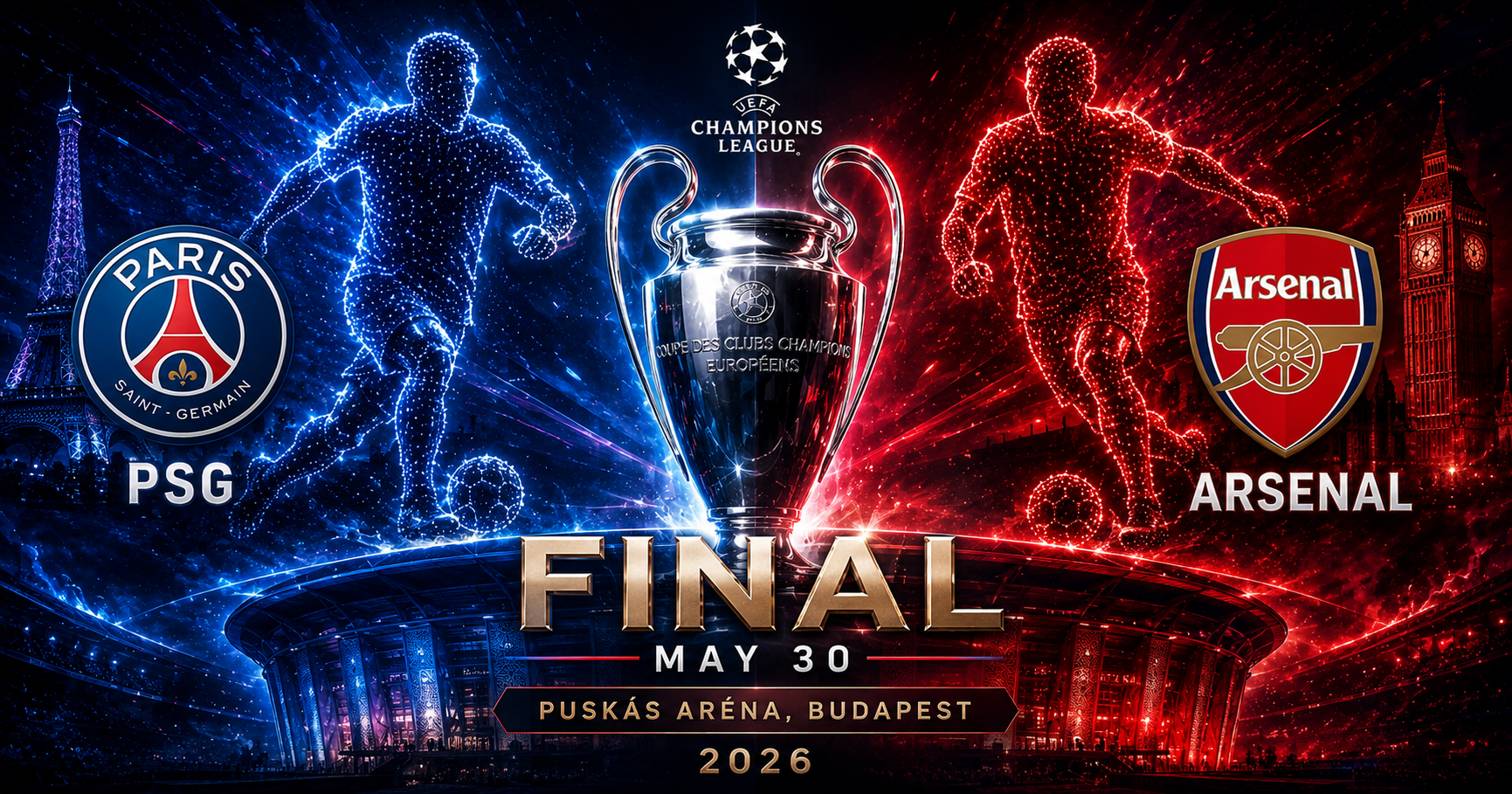
PSG are back-to-back Champions League winners. A penalty shootout at the Puskás Aréna in Budapest separated these two sides after a match that finished 1-1 after 90 minutes, and it was the French champions who held their nerve: 4-3 on penalties, their second consecutive European crown, and a place in history alongside Real Madrid as the only clubs to win consecutive Champions League titles in the modern era.
Arsenal came so close. Kai Havertz put them ahead in the 6th minute and they defended that lead for nearly an hour with exactly the composure and organisation that had carried them through 14 unbeaten games to reach this point. Dembélé’s penalty in the 65th minute forced extra time when normal time ended level. Then came the shootout. Then came heartbreak, again, in Paris’s colours, in a Champions League final, two decades after the Stade de France.
For PSG, this is the completion of something that has been building since Luis Enrique arrived. Two titles. Back to back. No longer a club defined by spending and falling short. A dynasty, however small its foundations still are.
Match Report
Arsenal drew first blood. Havertz met a low cross in the 6th minute and finished cleanly from inside the area, his goal coming before PSG had even settled into the game. For the next hour, Mikel Arteta’s side did what they had done all campaign: they defended in an organised block, pressed intelligently in transition, and gave PSG almost nothing to work with.
The stats from the Puskás Aréna tell the story of a match PSG dominated territorially but struggled to turn into chances. 72% possession, 21 attempts to Arsenal’s 8, 105 attacks to 26. And yet the scoreboard showed 1-0 to Arsenal for 59 minutes. That’s not an accident. That’s Arteta’s system doing exactly what it was designed to do.
The breakthrough came from the spot. A penalty was awarded to PSG in the 65th minute, and Dembélé stepped up and converted. It was only PSG’s 4th attempt on target all game. Arsenal had managed just 1. The rest was extra time, no further goals, and a penalty shootout that PSG won 4-3 to claim the trophy.
Arsenal’s unbeaten record in this campaign ended not with a defeat in regular time, but in a shootout after a game they arguably deserved to win. That will be cold comfort. History records the winner.
Key Match Stats
Those numbers deserve a moment. Arsenal ran 150.4km to PSG’s 143.8km. They committed 17 fouls to PSG’s 11, collected 5 yellow cards to PSG’s 2. That’s the portrait of a team that defended for their lives and fouled when they had to. That Arsenal managed just 1 attempt on target in a Champions League final and were still in the game at 1-1 after 90 minutes says everything about their defensive structure. It also says something about their limitations going forward against elite opposition.
PSG: Back-to-Back Champions
When PSG won their first Champions League title last season, beating Inter Milan in the final, people asked whether it was a one-off, whether the competition had just opened up enough for them to squeeze through. This season has answered that question definitively. They are not just good. They are the best team in Europe, and have been for the entire campaign.
What makes this PSG different from any previous version of this club is that they no longer rely on individual brilliance alone. Kvaratskhelia, Dembélé, Neves, Vitinha: this is a team that presses together, defends together, and transitions together. In Budapest, even when Arsenal frustrated them for an hour, PSG never panicked. They kept passing, kept moving, kept creating situations, until the penalty gave them the opening they needed.
Dembélé scored the equaliser and converted in the shootout. Kvaratskhelia was the creator throughout. Luis Enrique has built something genuinely sustainable at this club, and that might be the most remarkable achievement of the season.
“The best team has gone through. Has Dembélé got one hand on the Ballon d’Or again? Who knows.”
Steven Gerrard, TNT Sports, post-matchArsenal: Heartbreak, Again
The last time Arsenal played in a Champions League final was May 17, 2006. Paris. The Stade de France. They led Barcelona 1-0 with ten men before losing 2-1. Twenty years later, in Budapest, they lead PSG 1-0 for nearly an hour before losing on penalties. The symmetry is cruel.
This Arsenal team did nothing wrong tactically. Arteta set them up to frustrate PSG’s possession game and absorb pressure, then hit on the counter. Havertz’s early goal validated the plan entirely. For 59 minutes it was working. Arsenal were 90 minutes from their first European crown, playing some of the best defensive football a team has produced in a Champions League final in years.
The question the shootout raises is not about courage or preparation. It’s about the gap in attacking quality between the two sides. Arsenal’s 1 attempt on target across 90 minutes of a Champions League final against a team that had 72% possession tells you something real. PSG could create from nothing. Arsenal needed the perfect defensive performance to stay in it. They nearly got away with it.
Arsenal’s Champions League Final History
Key Players
Milos’s Take
I predicted PSG 2-1. I got the winner right. The scoreline was different, but the logic held: PSG had more quality in attack, and Kvaratskhelia was the difference at key moments. What I underestimated was how good Arsenal’s defensive plan would be, and how long they’d hold it for.
One attempt on target in a Champions League final. That’s the number that will haunt Arteta. Not because his team were bad; they were excellent defensively. But because against the best teams in Europe, you need more than one clean defensive performance. You need goals from somewhere.
For PSG, this is the validation of everything Luis Enrique has built. Two titles in two years. A team that wins with organisation and collective brilliance rather than individual stars carrying the weight. That’s genuinely new for a club that spent a decade buying stars and failing to build a team.
Arsenal will be back. This squad is young, unbeaten over 90 minutes in 15 Champions League games, and carries the structure of a team that will compete at this level for years. Budapest stings. But it’s not the end of the road.
The official match stats are available on UEFA.com’s match centre for the full breakdown. You can also revisit the semifinal previews for context on how both teams arrived here.
Who won the Champions League 2026?
Paris Saint-Germain won the 2026 Champions League, beating Arsenal 4-3 on penalties after the match finished 1-1 at the Puskás Aréna in Budapest on May 30, 2026. It is PSG’s second consecutive European title, following their 2025 victory over Inter Milan.
What was the score in the 2026 Champions League final?
The final finished 1-1 after 90 minutes and extra time. Kai Havertz scored for Arsenal in the 6th minute; Ousmane Dembélé equalised from the penalty spot in the 65th minute. PSG won the penalty shootout 4-3 to lift the trophy.
Who scored in the Champions League final 2026?
Kai Havertz scored for Arsenal in the 6th minute. Ousmane Dembélé equalised for PSG with a penalty in the 65th minute. No further goals were scored in extra time. PSG won the shootout 4-3.
Has Arsenal ever won the Champions League?
No. The 2026 final was Arsenal’s second Champions League final appearance and their second defeat. They previously lost to Barcelona 2-1 in Paris in 2006. Arsenal remain without a European Cup or Champions League title.
Is PSG the first team to win back-to-back Champions League titles recently?
Yes. PSG’s back-to-back titles in 2025 and 2026 make them the first team to win consecutive Champions League trophies since Real Madrid’s three-peat between 2016 and 2018. No other club has managed consecutive European Cup wins in that period.
What were Arsenal’s Champions League stats in 2026?
Arsenal finished the 2025/26 Champions League campaign with a record of W11 D4 L0 across 15 games, never losing in 90 minutes throughout the entire competition. They conceded just 6 goals in 15 games. Their unbeaten run ended only in a penalty shootout in the final.
PSG: Champions of Europe, Again
Two titles. Back to back. Luis Enrique has transformed Paris Saint-Germain from a club defined by expensive failures into a genuine European dynasty. That is not a small achievement.
Arsenal gave everything. An unbeaten campaign across 90 minutes in 15 games, a goal inside 6 minutes of the final, and a defensive performance that deserved more. Budapest will hurt for a long time. But this Arsenal team is not done.
The 2026 Champions League final will be remembered as the night PSG cemented their place in the competition’s history, and the night Arsenal came within a penalty shootout of ending 20 years of hurt. Both things are true. Both deserve to be said.